
Climate Change : Redrawing the Boundaries of the Wine World

Climate change isn’t just shifting temperatures—it’s redrawing the global wine map. At the center of this transformation lies one critical concept: Climate Niche.
A climate niche defines the precise environmental conditions where a grape variety performs at its genetic best, delivering consistent quality and yield. In today’s warming world, producing “good wine” is no longer enough. Long-term sustainability depends on planting the right grape in the right place—exactly where its climate niche exists.
The Ripening Paradox
Rising temperatures are disrupting the vine’s biological rhythm. Sugar levels increase rapidly as photosynthesis accelerates, while phenolic ripeness—flavor, aroma, and acidity—lags behind.
This is the Ripening Paradox: when sugar peaks, aroma is often still unripe.
Winemakers face a difficult choice—harvest early for balance but less complexity, or wait for flavor development and risk high alcohol with low acidity. Classic regions such as Tuscany, long defined by varieties like Sangiovese, are increasingly pressured to rethink tradition.
Taboos Shattered in Bordeaux
Even the most traditional regions are adapting. In 2021, Bordeaux approved six new “experimental” grape varieties to combat rising temperatures—an unprecedented move in a region historically devoted to Merlot and Cabernet Sauvignon.
Heat-tolerant grapes such as Touriga Nacional and Marselan are now officially permitted. The message is clear: to protect heritage, rules must evolve.
A similar struggle is unfolding in Napa Valley, where Cabernet Sauvignon faces mounting climate stress.
Title or Survival? Leaving the Appellations
Centuries-old appellation laws—once guardians of tradition—can now restrict adaptation. Irrigation bans and canopy limitations sometimes prevent producers from responding to extreme weather.
In a striking example, Château Lafleur announced it would leave the prestigious Pomerol label starting with the 2025 vintage, opting instead for the broader “Vin de France” category to gain flexibility.
This symbolic shift signals a new priority: climatic resilience over hierarchical status.
The Northward Turn: England & The Nordic Rise
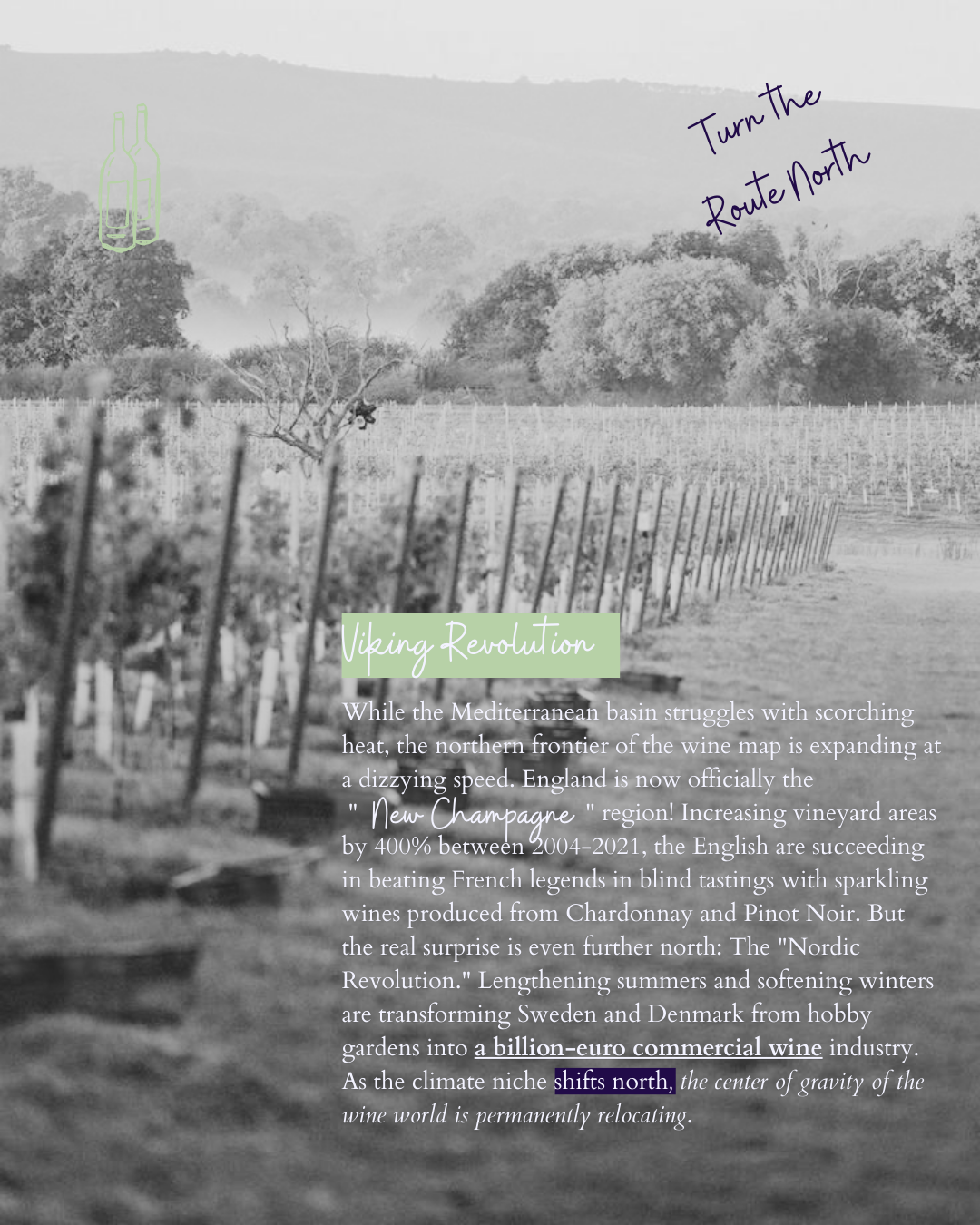
While southern Europe grapples with heatwaves, cooler regions are thriving. England has emerged as a serious sparkling wine contender, with vineyard areas expanding dramatically since the early 2000s. Wines made from Chardonnay and Pinot Noir increasingly rival Champagne in blind tastings.
Even further north, countries like Sweden and Denmark are transitioning from hobby-scale production to viable commercial industries. As climate niches migrate north, so does the wine world’s center of gravity.
Altitude is the New Latitude
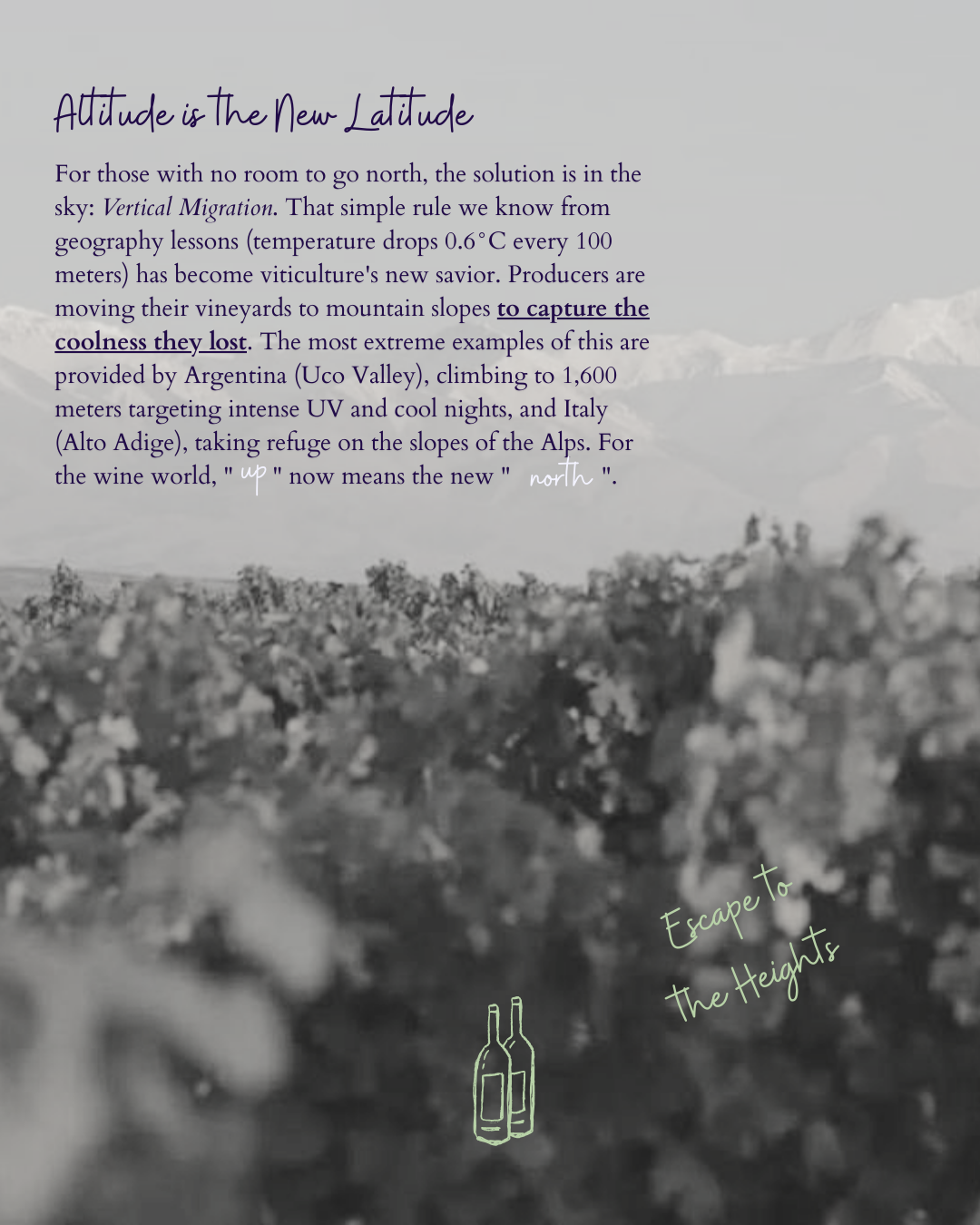
For regions that cannot move north, elevation offers refuge. The rule is simple: temperature drops about 0.6°C for every 100 meters of altitude.
In Uco Valley in Argentina, vineyards reach up to 1,600 meters, capturing cool nights and intense sunlight. In Alto Adige, producers retreat to Alpine slopes to preserve freshness.
For the modern wine world, “up” has become the new “north.”
The global wine landscape is no longer fixed by history alone. Climate niches are shifting, rules are bending, and geography is being rewritten.
The question is no longer whether change is coming.
It’s who will adapt fastest—and how boldly they are willing to redraw the boundaries.